Have you ever wondered what it would be like to live in a home that seems almost alive? A place where the walls breathe, the energy flows seamlessly, and the building quietly monitors its own health? That’s exactly what the Lib Earth House Model B in Yamaga, Kumamoto is showing us. Lib Work official site
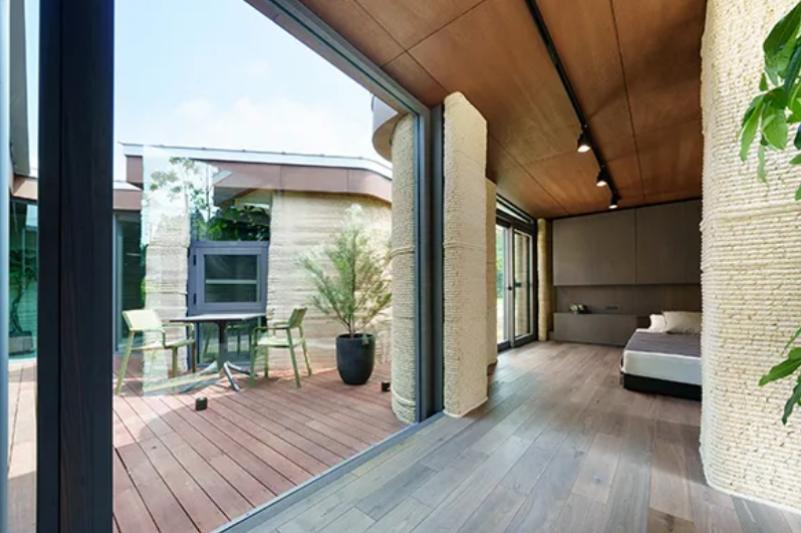
Instead of concrete, this 100 m² house is printed layer by layer using a mix of local earth, sand, lime, and plant fibers. Why these materials? They’re renewable, biodegradable, and widely available. At the end of its life, much of the house can naturally return to the ground—supporting circular economy principles. Isn’t that a smart way to think about construction?
How do they build it? A massive 3D printer from Italy’s WASP, in partnership with Arup engineers, lays down the earthen mixture. Once the shell is ready, the timber frame, roof, windows, and interior finishes are added. Even though it’s mostly soil, the walls meet Japan’s highest seismic safety grade (Grade 3)—proving that low-carbon building materials can be both sustainable and strong.
What about carbon emissions? Building this way cuts CO₂ output by nearly half—down from 45,000 kg to just 22,400 kg for a house of this size. That’s even cleaner than many wood-framed homes, according to lifecycle assessments. Plus, 3D printing allows for curves, fluid layouts, and unique designs that bricks and boards simply can’t achieve.
Ever thought about combining sustainability with smart tech? Model B includes a facial-recognition entry system, adding convenience without compromising eco-friendly design. The house runs entirely off-grid, with solar panels feeding a Tesla Powerwall battery, and sensors embedded in the walls monitor humidity, insulation, and durability—showing how building performance monitoring can make a home smarter and greener.
What’s next for this innovation? Lib Work aims to deliver 10,000 homes by 2040, and they’re exploring ways to automate the printing and finishing process—making sustainable homes scalable worldwide. They even imagine building on Mars using robotic printers with Martian soil. Could off-world architecture really be inspired by sustainable Earth designs?
If you’re curious about these futuristic methods, PAACADEMY’s 3D Printing Courses let you get hands-on and start building the future from the ground up.
— Marlon Amele
 Marlon Amele | Life. Construction. Legacy.